The mathematics of memory
The Neural Map winds your memories onto
mathematical objects. Every topology
below is a real parametric structure: the equations are the exact ones
the engine computes (and the map displays) when your memory takes that
shape.
Why mathematics? Because a form with structure can be navigated. A
spiral has an inside and an outside, a knot has crossings, an attractor
has flows. Position becomes meaning, and your memory becomes a space
you learn the way you learn a place. Sailors had the stars; you get
nineteen skies.
Chaotic attractors
Lorenz Chaotic Attractor
Integrating the Lorenz system from a seed point produces non-linear chaotic
dynamics: the butterfly.
dtdx=σ(y−x), dtdy=x(ρ−z)−y, dtdz=xy−βz(x0,y0,z0)=(0.1,0,0)
Rössler Attractor
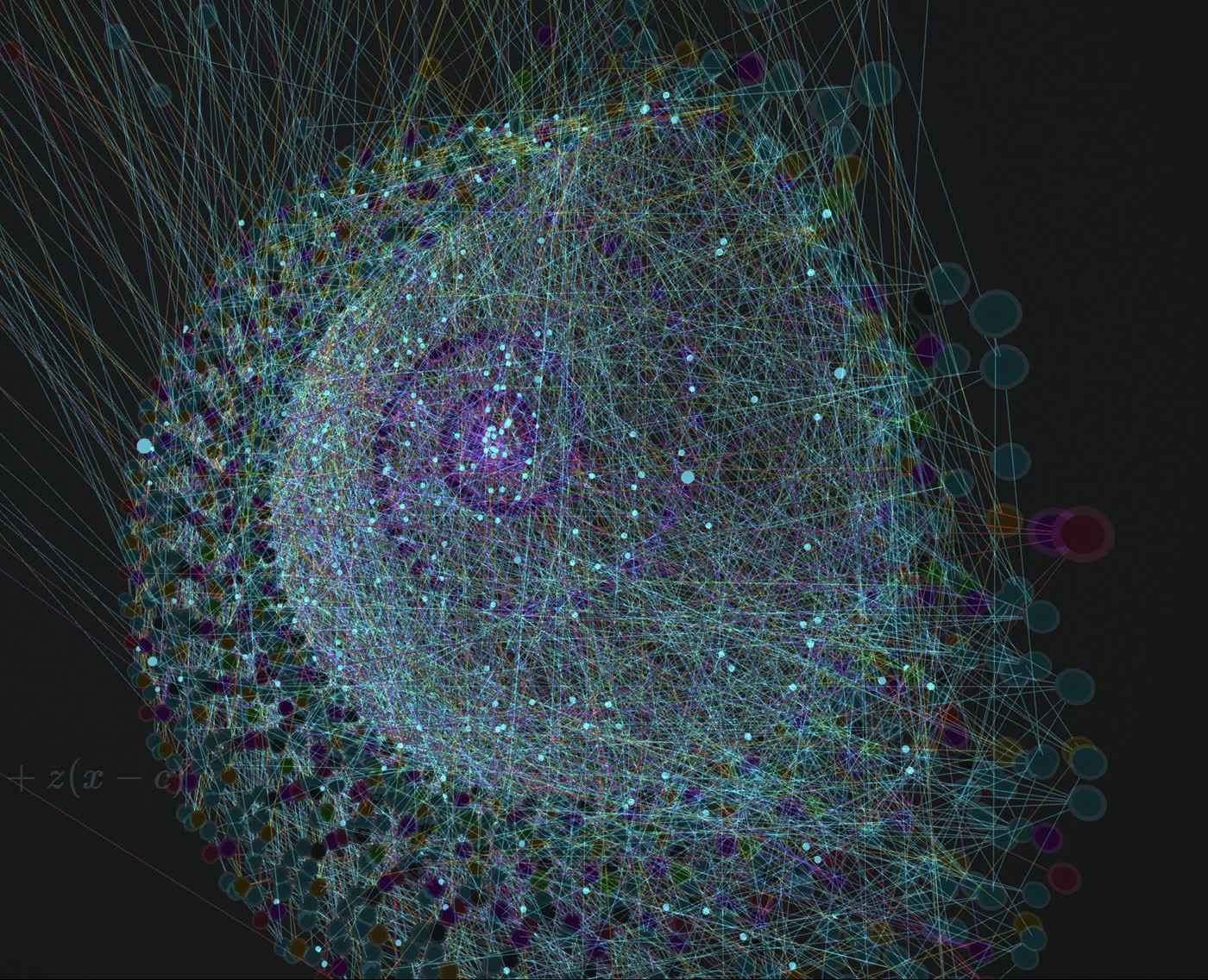
The Rössler system's chaotic differential equations, folded into a
single-loop ribbon.
dtdx=−y−z, dtdy=x+ay, dtdz=b+z(x−c)(x0,y0,z0)=(0.1,0.1,0.1)
Minimal surfaces
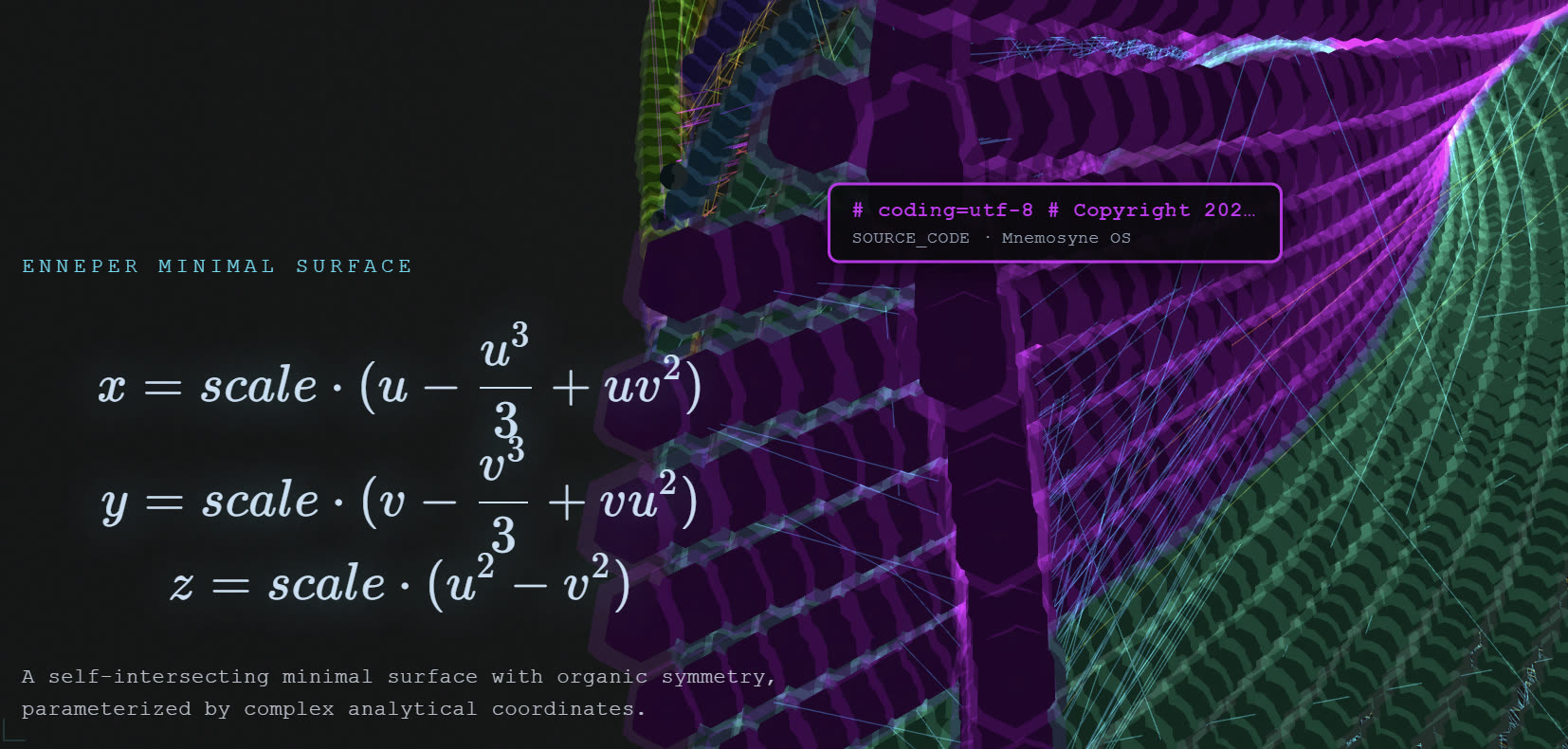
Enneper Minimal Surface
A self-intersecting minimal surface with organic symmetry, parameterized
by complex analytical coordinates.
x=scale⋅(u−3u3+uv2)y=scale⋅(v−3v3+vu2)z=scale⋅(u2−v2)
Catenoid Surface
The minimal surface of a rotated catenary, the physical shape of soap
film tension.
x=ccosh(u)cos(v)y=u⋅Lz=ccosh(u)sin(v)
Hyperbolic Paraboloid
An open saddle, with hyperbolic geometry and infinite expansion tangents.
z=1.2Rx2−y2x=rncos(θn)y=rnsin(θn)
Pseudospheres & shells
Dini's Surface
A helicoidal pseudosphere of constant negative curvature, a spiraling
horn.
x=acos(u)sin(v)y=asin(u)sin(v)z=a(cos(v)+lntan(v/2))+bu
Logarithmic Seashell
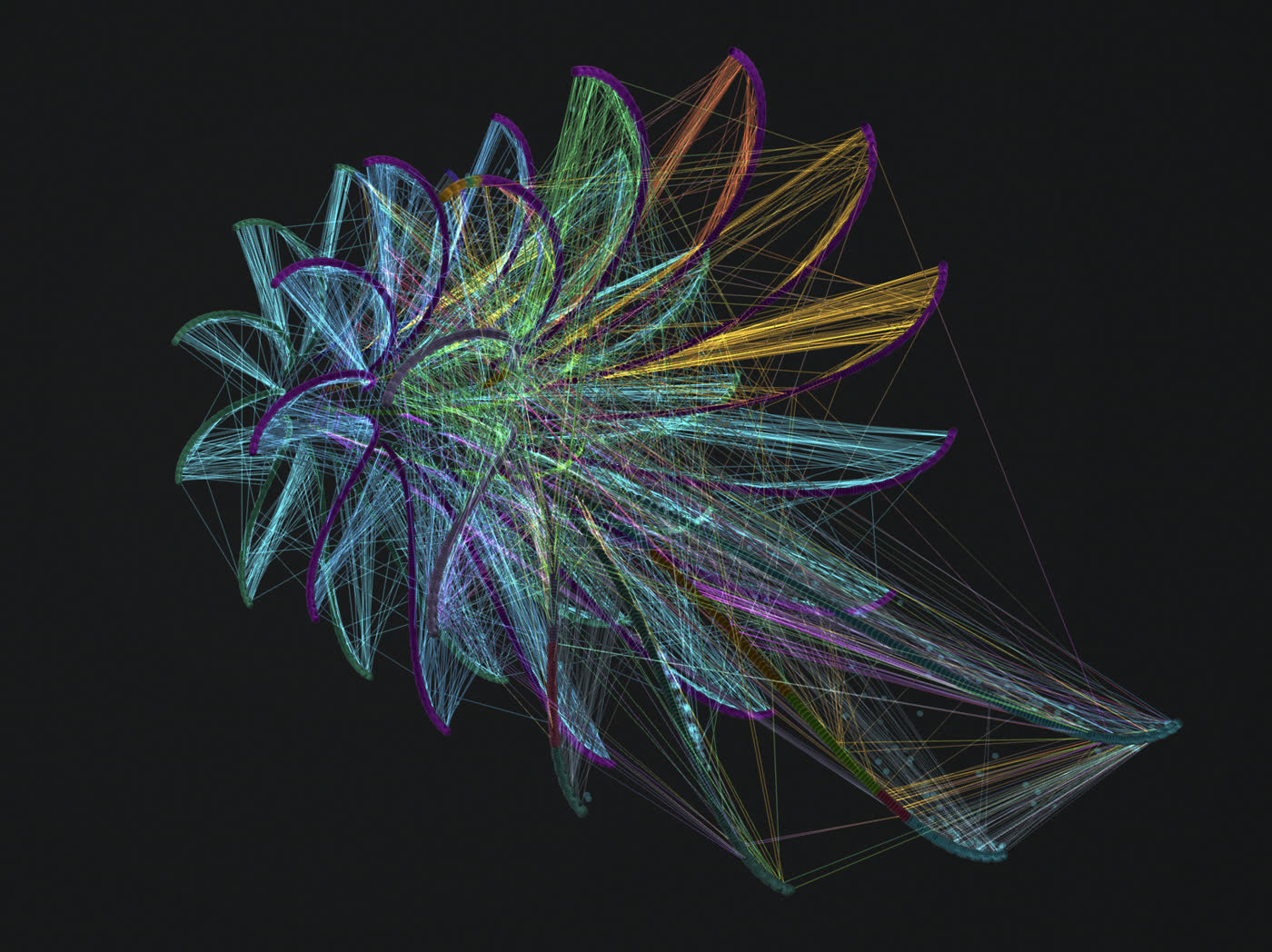
A logarithmic spiral cone, memory mapped to shell morphogenesis.
x=aebu(1+cos(v))cos(u)y=aebu(1+cos(v))sin(u)z=aebusin(v)−H
Tori & non-orientable surfaces
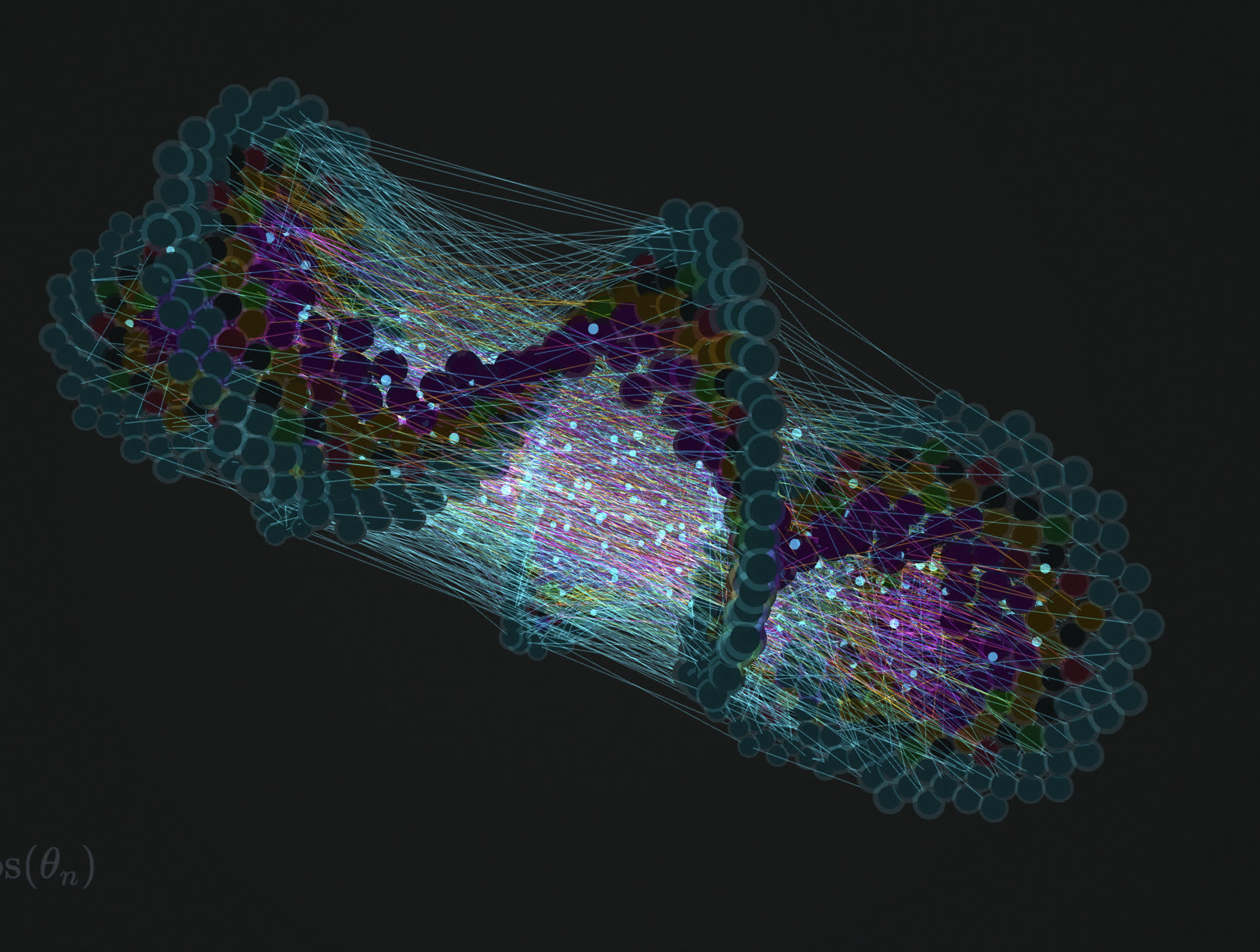
Toroidal Ring
Prime sequences wrapped on a torus, structural harmonics split into
major and minor windings.
x=(R+rtubecos(ϕn))cos(θn)y=rtubesin(ϕn)z=(R+rtubecos(ϕn))sin(θn)
Clifford Flat Torus
The 4-dimensional flat Clifford torus, stereographically projected from
the 3-sphere into 3-space.
x=2−cos(v)Rcos(u)y=2−cos(v)Rsin(u)z=2−cos(v)Rsin(v)
Möbius Strip
One side, one edge, non-orientable flows.
x=(R+vncos(θn/2))cos(θn)y=vnsin(θn/2)z=(R+vncos(θn/2))sin(θn)
A 3D projection of the non-orientable Klein bottle, a manifold that
passes through itself.
x=(R+cos(2θn)sin(vn)−sin(2θn)sin(2vn))cos(θn)y=sin(2θn)sin(vn)+cos(2θn)sin(2vn)z=(R+cos(2θn)sin(vn)−sin(2θn)sin(2vn))sin(θn)
Knots & links
Trefoil Knot Manifold
The Fermat prime spiral wrapped onto the simplest non-trivial knot.
x=R(sin(θn)+2sin(2θn))y=R(cos(θn)−2cos(2θn))z=−Rsin(3θn)
Torus Knot (8,3)
Eight times along the tube, three times around the axis.
r=R+r0cos(8θ)x=rcos(3θ)y=r0sin(8θ)z=rsin(3θ)
Borromean Rings
Three orthogonal rings, none linked to any other, yet the trio cannot
be separated.
R1:(x,y)∈ellipse, z≈0R2:(y,z)∈ellipse, x≈0R3:(x,z)∈ellipse, y≈0
Helices & spirals
Cylindrical Helix
Fermat's prime spiral extruded along the Y axis, heights scrambled to
expose nested structures.
x=rncos(θn)y=hn⋅Lz=rnsin(θn)
Double Helix Structure
Two intertwined helices, DNA-like double strands.
x1=Rcos(θn), y1=hn⋅L, z1=Rsin(θn)x2=Rcos(θn+π), y2=hn⋅L, z2=Rsin(θn+π)
Fermat Spiral Disk
A flat Fermat spiral with a whisper of depth for perspective.
x=rncos(θn)y=rnsin(θn)z∈[−25,25]
Spheres & stars
Spherical Nebula
Spherical Fibonacci coordinates, nodes dispersed volumetrically, never
compressed into a shell.
cos(ϕn)=1−N−12ix=rnsin(ϕn)cos(θn)y=rncos(ϕn)z=rnsin(ϕn)sin(θn)
Astroidal Star
An astroidal ellipsoid, six orthogonal cusps.
x=Rcos3(v)cos3(u)y=Rsin3(v)z=Rcos3(v)sin3(u)
Every one of these is available from the map's
Geometry panel. Switch topologies freely, and
your memory re-winds in place.
And if memory needs a cosmos to be navigable, maybe that's why the cosmos
feels so much like a memory.