Memory recall
Every answer in Mnemosyne OS starts before the model writes a word. Recall goes into your vaults and picks the memories the answer will stand on. You've been using it since your first conversation, and this page shows you the machine and its dials.
Two ways of finding
Human questions come in two shapes, and recall searches both ways at once:
- By meaning: your memories live as vectors in semantic space, so « that idea about paper-based design » finds the right chronicle even when it never contains those words.
- By exact words: a second, purely lexical channel catches what semantics alone can miss, like the precise name, the code identifier, or the reference number you typed exactly.
The two channels are fused by rank, each one voting with its ordering rather than its raw scores. A memory both channels like rises, and a memory only one channel likes still gets its chance.
You aim it
Recall is steerable at three levels, all of them yours:
- Per conversation: the scope selector, All, one Vault, or Off.
- Per vault: each vault's RAG attention dial. A hobby vault can whisper while your work vault speaks.
- Per question: the thinking mode. Rigorous restricts answers to what memory proves, while Balanced and Visionary loosen the grip and still name their sources.
The retrieval journal
Recall keeps a lab notebook. In Settings, the retrieval journal records every memory search: what it was allowed to read, how it was tuned (how many memories it pulls, which query mode, whether it re-ranks them, how much it favors recent ones), how long each stage took, and what it came back with, each source scored.
When the best score of a search comes back red, that retrieval was weak. Three things to try, in that order: pull more memories, change the query mode, loosen the re-ranking.
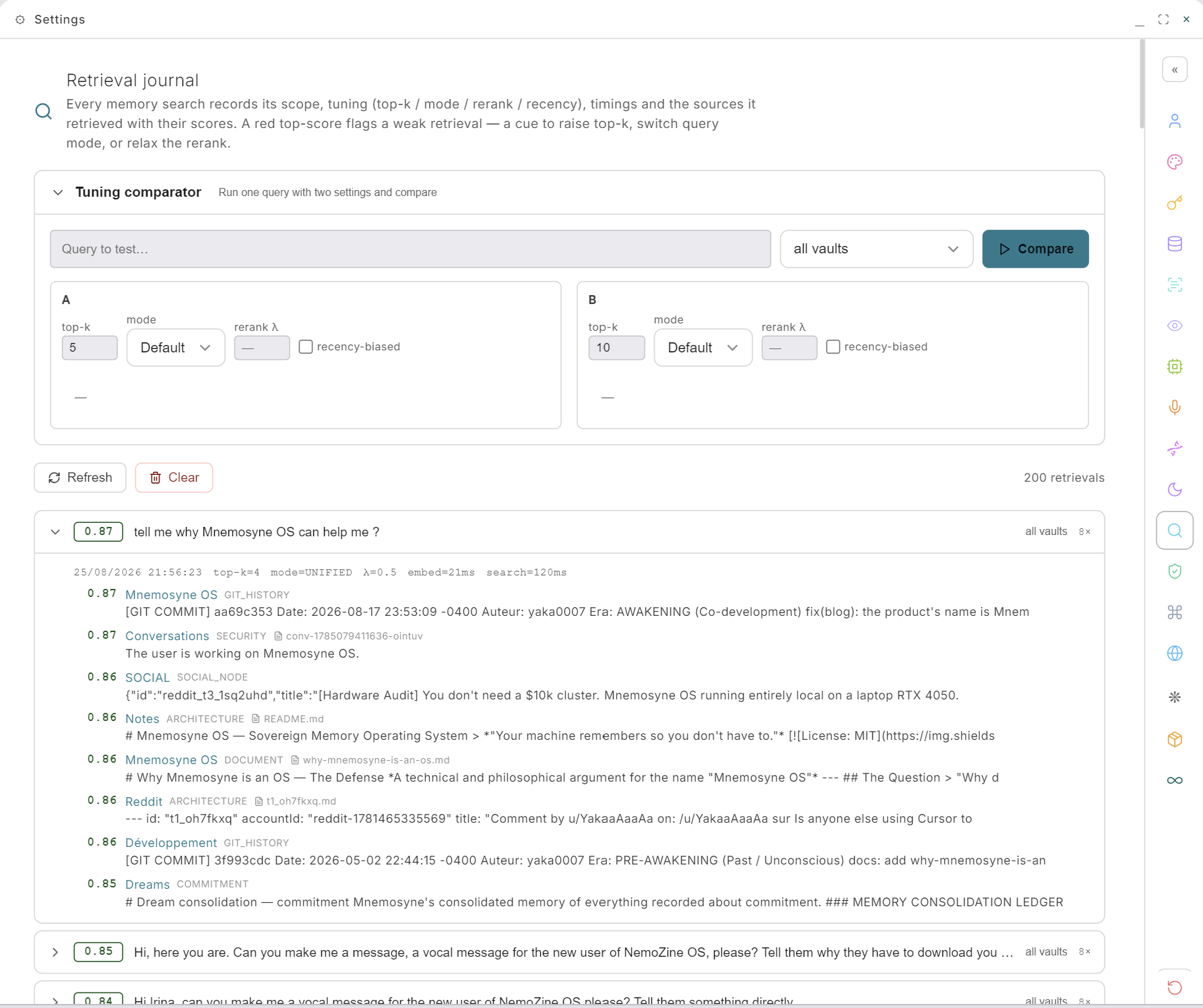
The tuning comparator above it runs the test for you: one question, two settings, the two results side by side. You see what pulling more memories or changing mode actually does before you commit to it.
Answers carry their receipts
A recalled answer is a claim with sources:
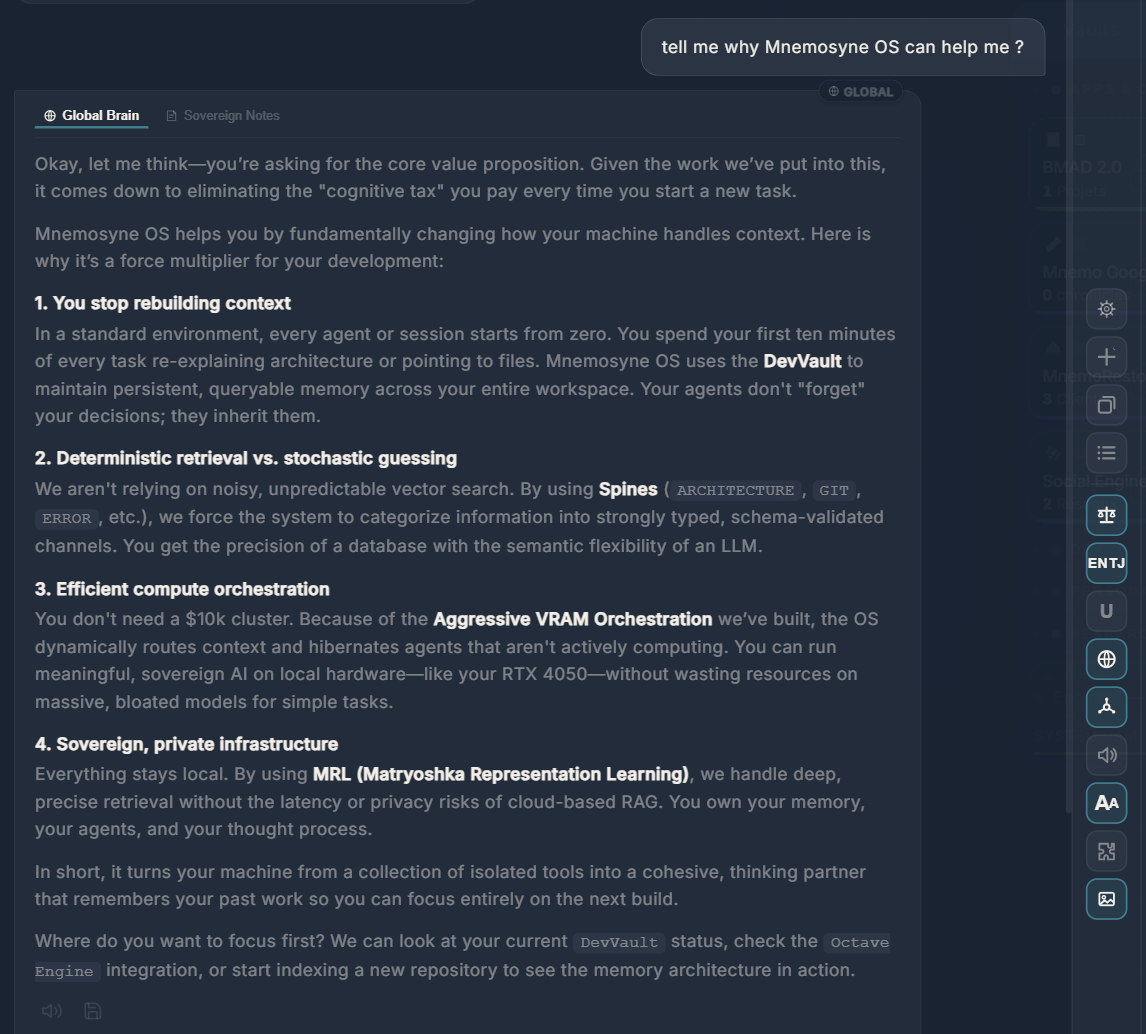
Unfold the sources and every memory that fed the reply is there, with its vault, its spine, its score and its file:
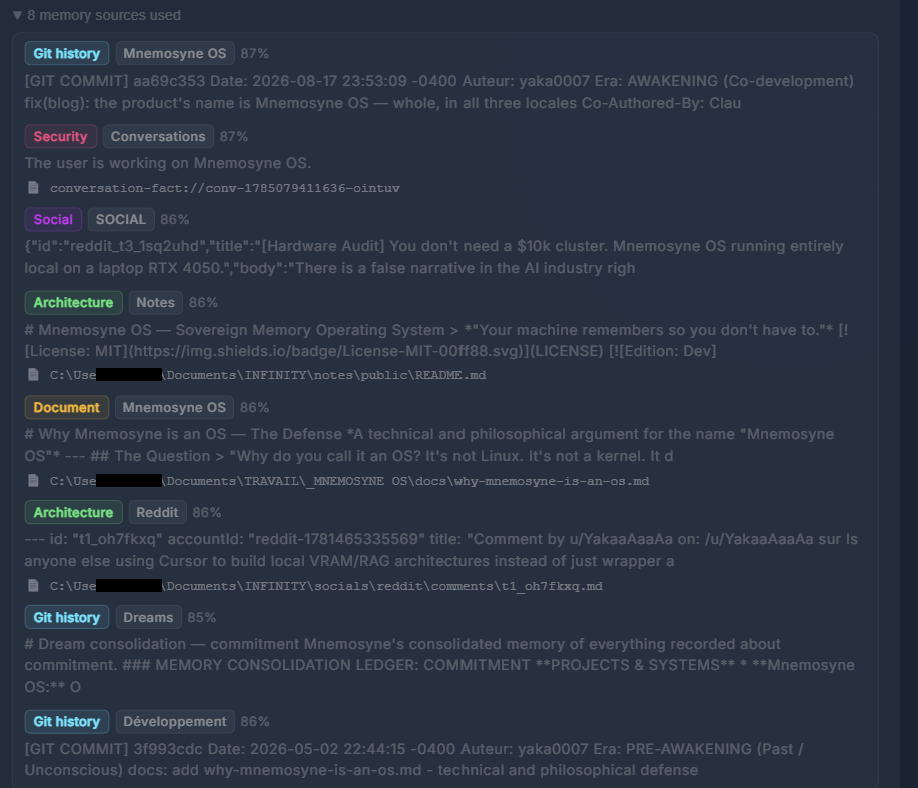
A git commit at 87%, a conversation fact, a Reddit thread, a note, a document, each one traceable to its chronicle, its file, its vault.
And when Theia recalls images, they appear the same way, as typed thumbnails under the answer. Watch it live:
The answer names its files, counts the full set, and offers view all to scan the rest. The footer lists the vaults it did not read, provisional vaults included.
When memory does not cover it
When your memory doesn't cover a question, recall says so. If you enabled Open mind, the model may complete with general knowledge, clearly labeled, and Rigorous mode ignores even that.
Recall also gets better while you sleep. The Dream State writes consolidated summaries and bridges between your memories, and those become recallable too: tomorrow, the same question can surface a connection that no single memory held today.