Morpheus, the Dream State
In the old stories, Morpheus is the shaper of dreams, from morphē, the form. The name fits: this engine shapes what it sleeps on. The app labels it Dream State today.
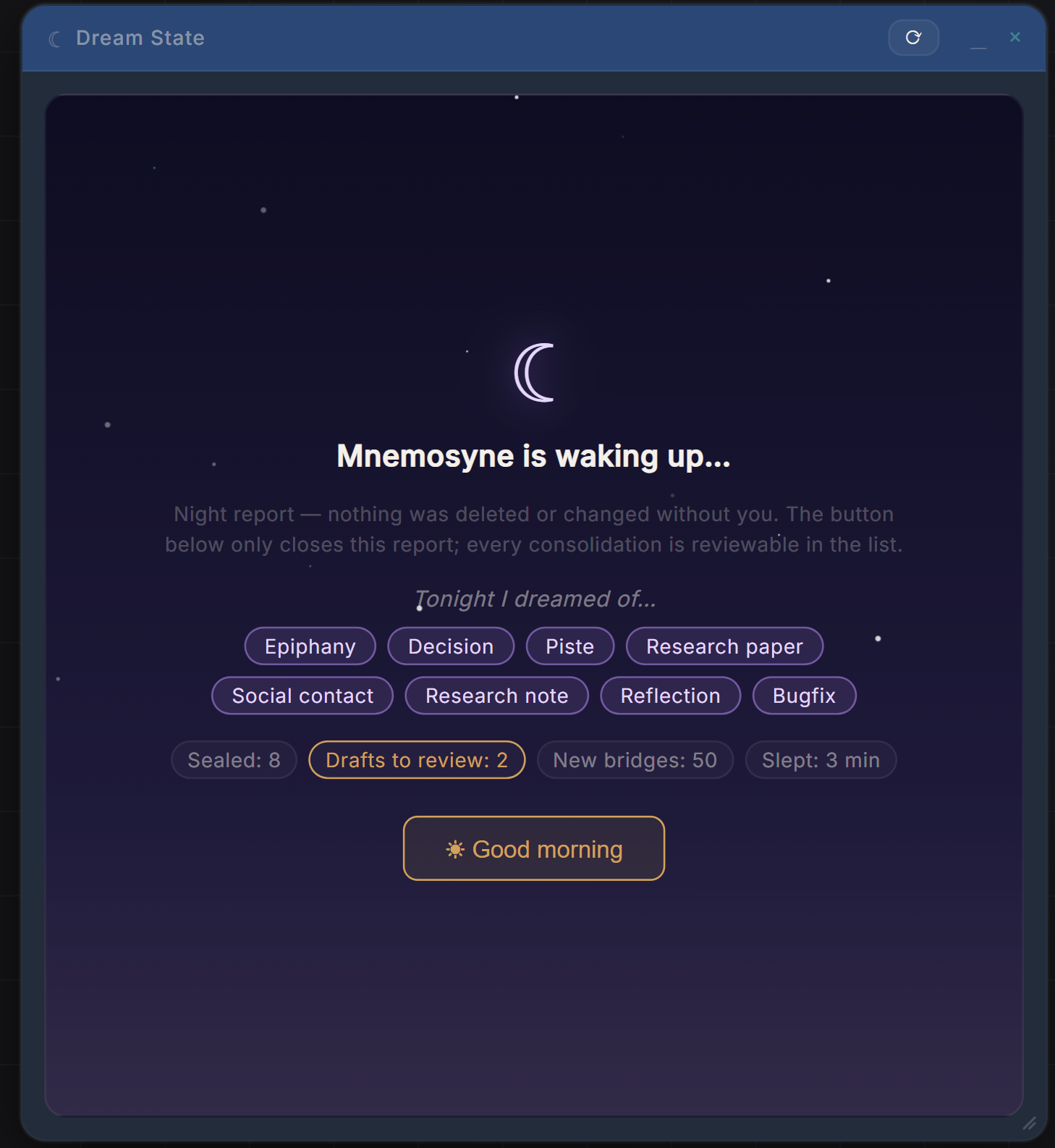
Every other feature of the OS works while you use it. Dream State works while you don't. When things go quiet, Mnemosyne OS consolidates what the day brought, and in the morning she tells you what she dreamed:
The night report, decoded
- « Tonight I dreamed of… »: the families of memories the dream touched, an Epiphany, a Decision, a Bugfix, a Research note… Your spines guide the dreaming toward what matters to you.
- Sealed: consolidations completed and written down.
- Drafts to review: the ones that wait for your judgment before becoming memory. The dream proposes, you dispose.
- New bridges: the number that says the most about this engine, connections found across spine families. Fifty bridges means fifty places where a research note touched a decision, where a bugfix echoed an epiphany, the unexpected insights no search would have surfaced.
- Slept: how long the dream ran.
What a dream actually does
Two jobs, every night:
- Consolidate: the day's chronicles are digested into durable structure, so recall gets sharper instead of noisier as your memory grows.
- Associate: the engine deliberately looks across your spine families for connections you didn't make yourself. That's where the bridges come from.
How it wanders: the prime stride
A dream can't reread your whole memory every night, so it samples. And the way it samples is pure Mnemosyne OS: the scanner walks the corpus with a prime-numbered stride. A prime step that doesn't divide the corpus size cycles through every memory exactly once before ever repeating one, so you get full coverage with no favorites and no blind spots. Each night the walk starts at a different prime offset, so successive dreams pair different memories together instead of redoing the same rounds.
That stride is what keeps the dream out of a rut. It cannot spend its nights re-reading the same corner of your memory, because the arithmetic will not let it.
The engine room
Open the Dream State widget and you're in the cockpit:
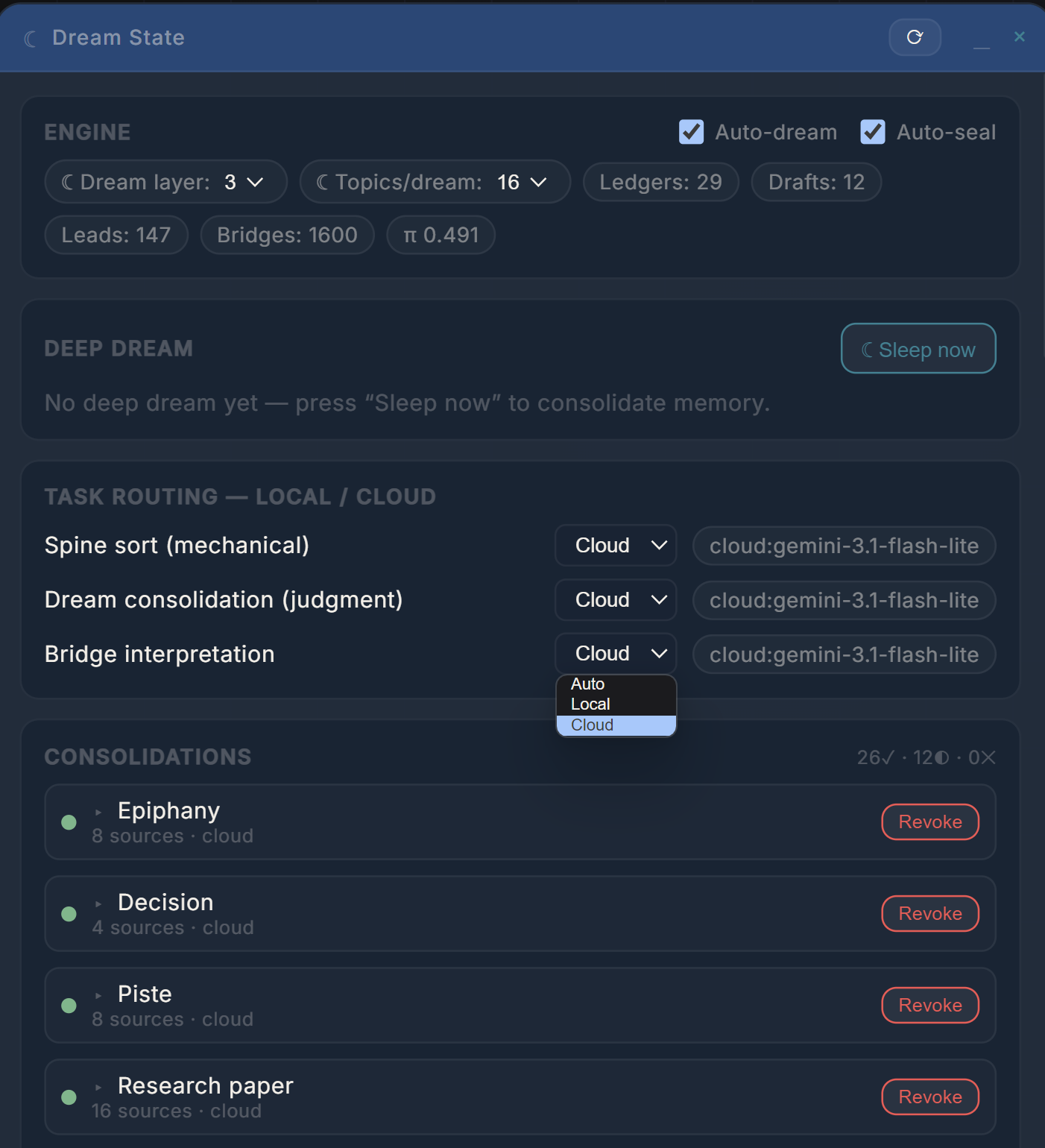
- Sleep now: press it and she dreams on demand, without waiting for the night.
- Auto-dream / Auto-seal: let the cycle run by itself, or take the wheel.
- Dream layer and topics per dream: how deep and how wide each dream goes. The counters (ledgers, drafts, leads, bridges) show what the dreaming has built over time.
- Task routing, Local / Cloud, per job. The dream has three trades: spine sort (mechanical), dream consolidation (judgment) and bridge interpretation. Each one routes independently, Auto, Local, or Cloud. Mechanical sorting can ride a fast cloud model while the judgment stays wherever you decided it lives.
Nothing moves without you
Read the report's own words: nothing was deleted or changed without you. The Good morning button only closes the report, and approves nothing. Every consolidation stays reviewable in the list, and the drafts wait explicitly for your verdict. The dream is an assistant that worked all night and left its proposals on your desk.
Every consolidation in the list carries its sources, its route, and a Revoke button. And when the dream isn't proud of a result, it says so:

« quality gate failed »: the dream flagged its own work as not good enough, kept it out of your memory, and waits for you to approve or revoke. An engine that grades itself and shows you the bad grades is rarer than it should be.
Closing time
Quit the app and Mnemosyne offers one last service before she sleeps:
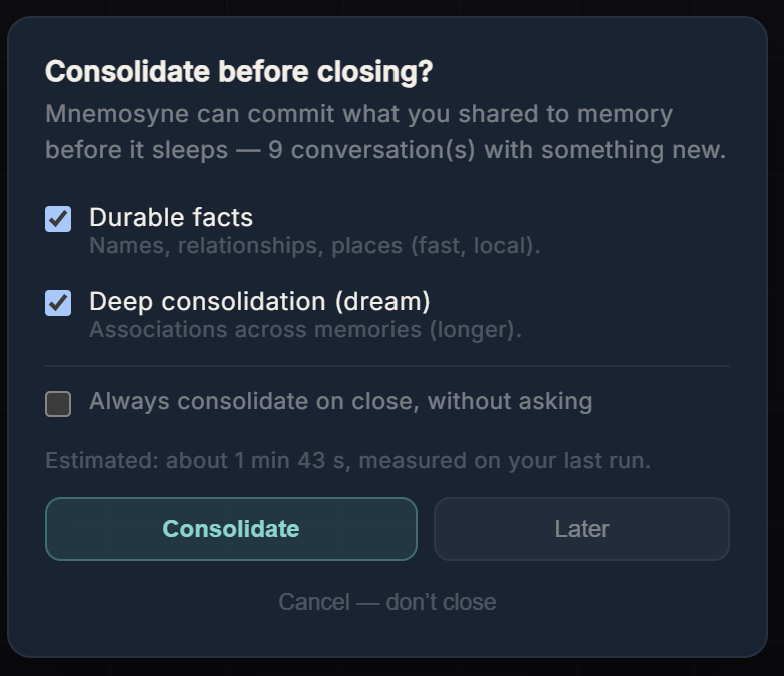
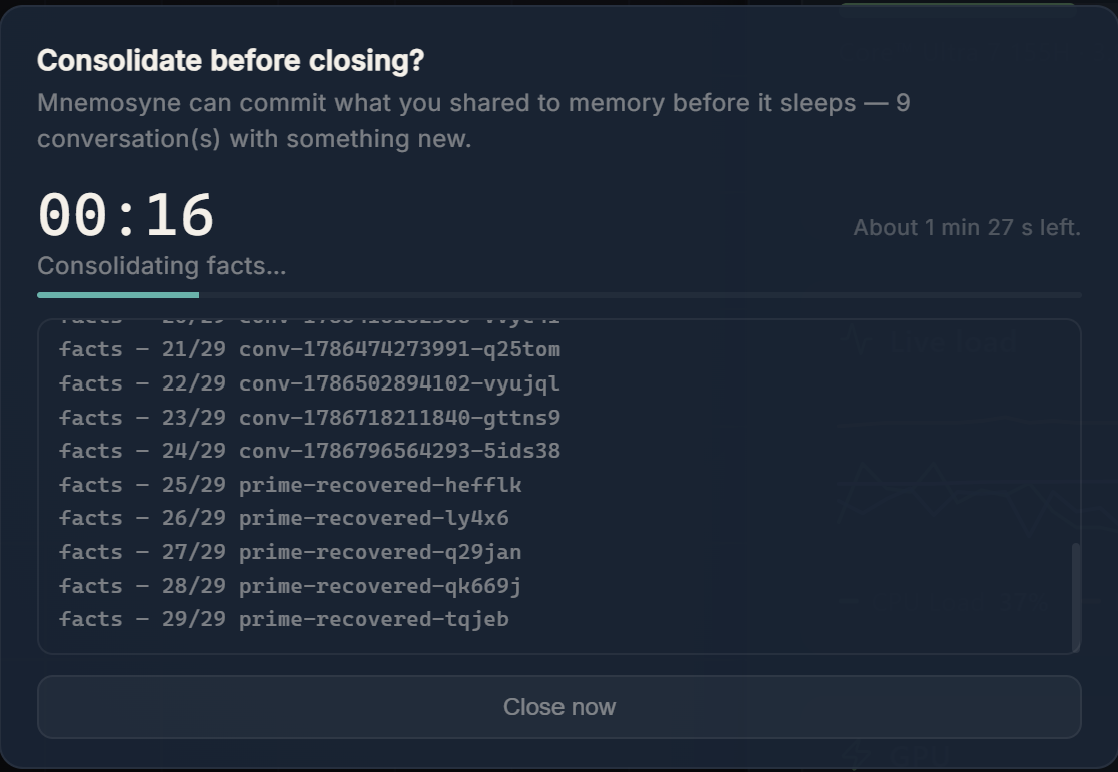
Two kinds of work, each with its checkbox: durable facts (names, relationships, places, fast and local) and deep consolidation (the dream, associations across memories, longer). The estimate is measured on your last run, and « Always consolidate on close, without asking » is an opt-in you tick. While it runs you watch every step, and Close now stays one click away: