Chronicles & spines
Two words carry the whole model. A chronicle is one memory. A spine is its nature. Everything else in the OS reads those two.
A chronicle is one memory
Not one file, not one conversation. One memory, small enough to be recalled on its own. A long document becomes many chronicles, each independently retrievable, which is why recall can hand you the one paragraph that answers your question instead of the whole PDF.
Each one carries:
- Its content, plus the vector that places it in semantic space.
- Its spine, the nature described below.
- Its vault, which decides who may read it.
- Two dates. The moment it entered memory, and the moment the source itself was born or last changed: a file's creation date, a commit's date. Recall ranks on the second one, so a note written in 2019 and indexed today still reads as 2019.
- Its origin, the file, the commit, the conversation or the capture it came from. This is what lets every answer name its sources.
- A fingerprint of the content. The same text ingested twice does not become two memories.
A spine is its nature
A spine says what kind of thing a memory is. An idea is not a bugfix, a commitment is not a passing thought, and the OS treats them differently:
- Recall weighs them differently. A decision and a git commit do not carry the same authority when answering a question.
- The Neural Map colors by spine, and can group by it. Each family forms a visible band, and your memory takes a shape you can navigate.
- The Dream State reads across them. It looks for connections between spine families, which is where the surprising ones live.
The taxonomy has two levels: natures at the top, sub-spines underneath. Seventeen natures and forty-seven sub-spines ship with the OS.
The twelve core natures
Universal, installed for everyone.
| Nature | What it holds | Some of its sub-spines |
|---|---|---|
| Document | A document you keep | |
| Note | Something you wrote down | |
| Idea | A thought that went somewhere | Epiphany, Hypothesis, Discovery, Resonance, Lead, Vision |
| Journal | The reflective and the felt | Diary, Dream (one you recorded), Thought, Reflection, Emotional, Concern, Tension, Flow |
| Conversation | A session with your AI | |
| Profile | Durable facts about you and your world | Person, Relationship, Place, Preference, Commitment |
| Media | Where images land, before you file them under a category of your own | |
| Reference | A pointer to something outside | |
| Task | Something to do | |
| Decision | A choice, and why | |
| Dream | An association the engine proposed while you slept | |
| Inbox | Everything not yet sorted |
Three more packs ship alongside, and they carry their own natures:
- Dev: Source code (Bugfix, Refactor, Feature, Architecture, API, Dependency, Security, Error, Debug), Git history, Session.
- Research: Research paper (Research note, Dataset, Revision, Theorem).
- Social: Social, with one sub-spine per network and kind of post.
Nothing is ever dropped for lack of a label. A memory whose nature cannot be determined lands in Inbox, where you can find it and move it.
Where chronicles come from
Every engine of the OS writes the same unit:
- Watched folders: files read and cut into chronicles, classified by what they are.
- Conversations: the session is mirrored, and the durable facts inside it are extracted into their own Profile atoms. A whole chat averaged into one vector cannot answer “what is my daughter's name”, one atom can.
- Notes you write in the app, with the spine you choose.
- Web captures, one human gesture per capture.
- Images, on their own channel, with their own categories.
- Dreams, the associations the engine proposes overnight.
- Agents, through MCP or a cartridge, each writing into the vault you granted it.
The spines you pick when you set up the app tell the engines which families matter to you:
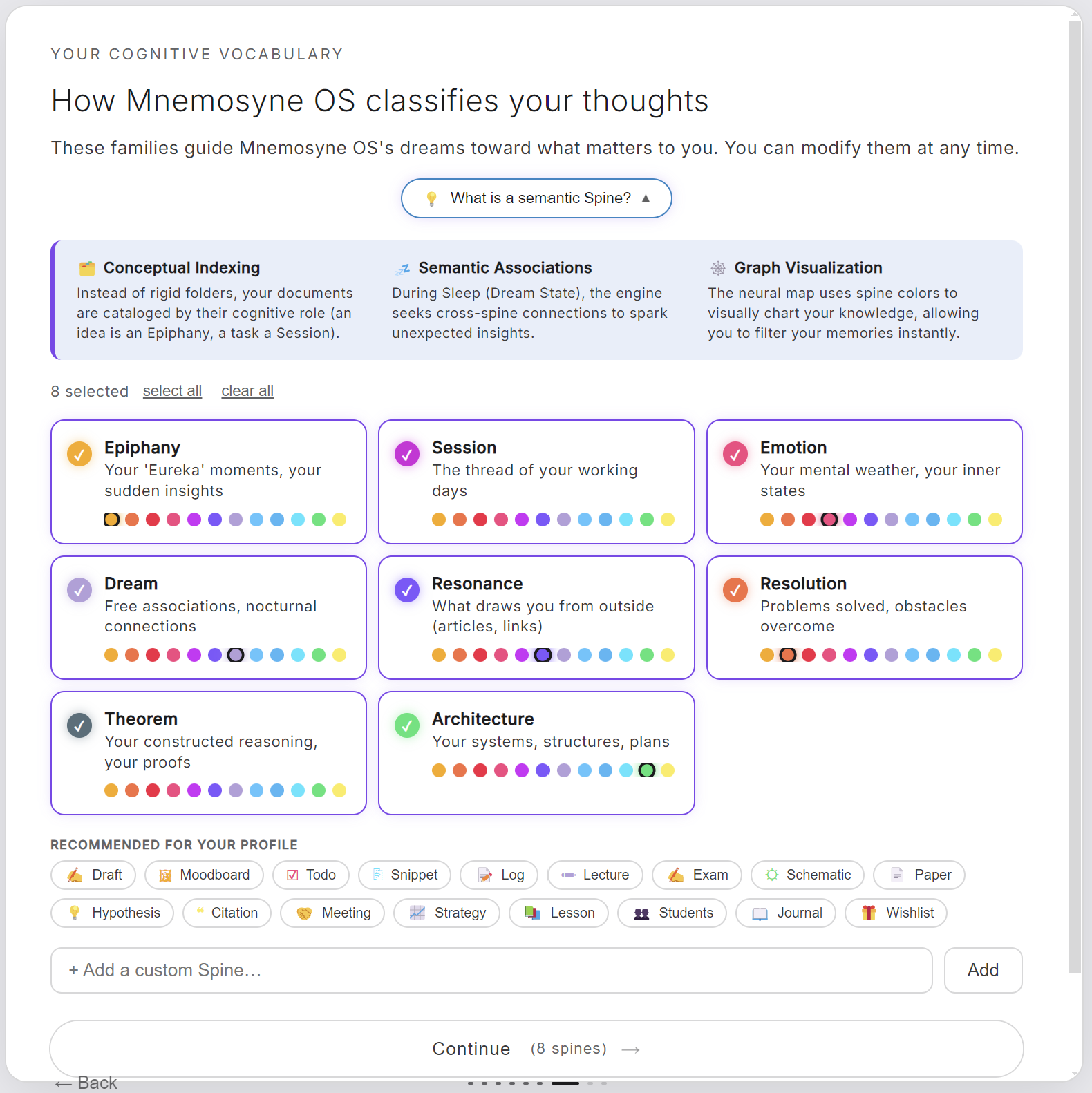
Shaping the taxonomy
Settings → Spine Studio puts the whole tree in front of you: every nature, its sub-spines, and the ones you added yourself.
- Add a sub-spine under any nature, with your own id and label. The system ones cannot be removed, yours can.
- The acronym lens collects every acronym defined anywhere in your memory, a glossary you never wrote.
- Nocturnal sort: a local model reviews your memory at night and proposes emergent sub-spines, with the count of chronicles that would move under each. Every proposal waits for your Approve or Dismiss. The naming model is yours to pick, and left empty the naming stays offline.
A vault can also reclassify what it already holds, and a watched folder can force one spine on everything it brings in.
Finding one again
-
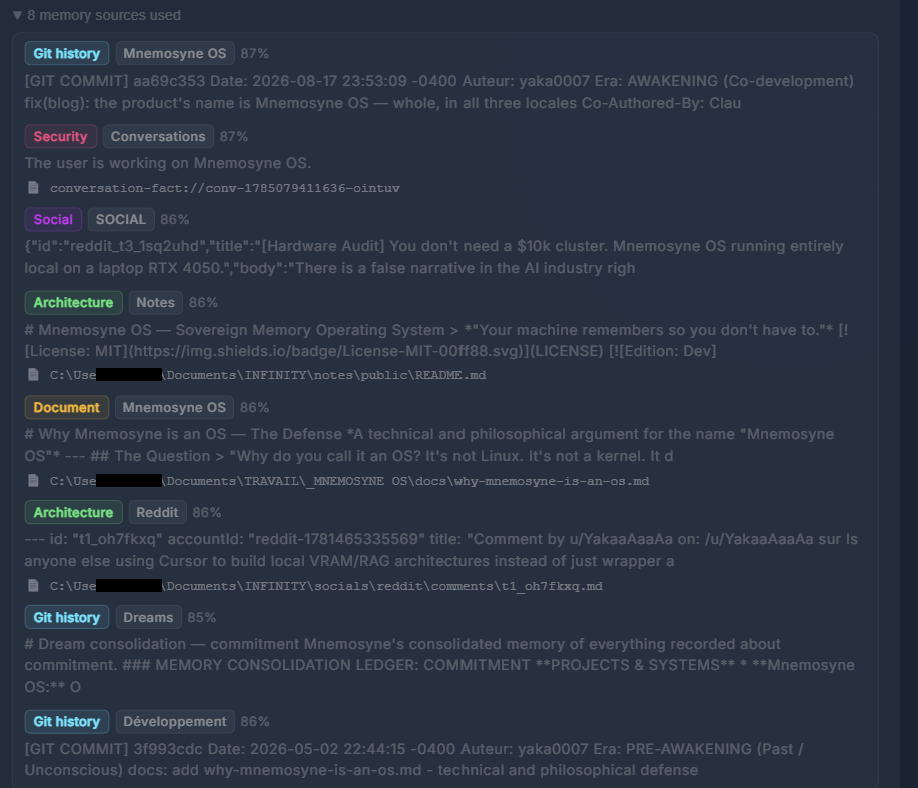
Ask. The sources rail under each answer names every chronicle it used, with its vault, its spine, its score and its file:
-
The Neural Map is the browsable view. Search a node by name and the camera flies to it, colors read as spines, and the legend toggles a whole family on or off.
-
The gallery for images, which have their own categories and their own spine you can name.