System Diagnostics — watch it work
Sovereignty you can't verify is just marketing. The System Diagnostics widget shows what Mnemosyne OS costs your machine, live — processor, memory, GPUs, every model held in RAM, and every byte that crosses the network. The readings below come from a real working session (an image-library indexing running in the background); your numbers will differ.
The vitals
CPU, memory, and a live four-curve graph — processor, RAM, GPU and VRAM over the last minutes:
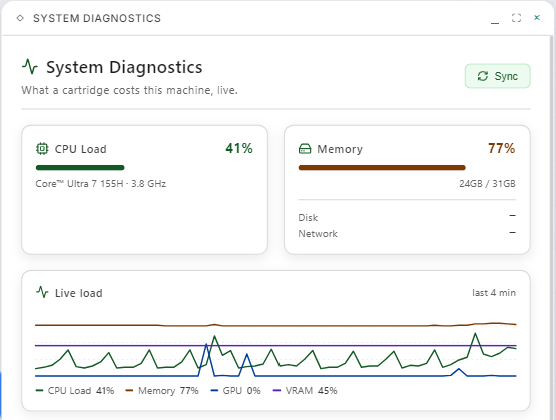
In this reading the OS is indexing a whole image library, and the machine sits at 41% CPU — usable, not hostage.
The GPU, respected
Both GPUs are watched — load, VRAM, temperature:
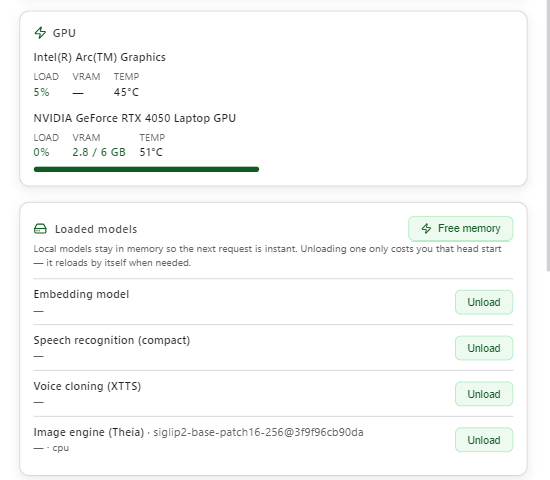
Look at the NVIDIA line during that same indexing run: 0% load, 51°C, 2.8 GB of VRAM parked. Background work never steals your graphics card — you can game, edit video or work while the OS indexes. That's a design decision, not luck (next section).
Loaded models — and the CPU trick
Every engine currently held in memory is listed, each with its own Unload button. The widget says it best: local models stay in memory so the next request is instant — unloading one only costs you that head start; it reloads by itself when needed.
The line that explains the quiet GPU: the Theia image engine —
siglip2-base-patch16-256, a 400-million-parameter vision-language
encoder — runs marked cpu. Image indexing is deliberately routed to
your processor's cores: it takes longer, but it never chokes your VRAM,
never crashes an ordinary machine, and never asks you for a
professional graphics card. Semantic image search on regular hardware —
that's the point.
Mnemosyne on the wire
The counter that settles the sovereignty question:
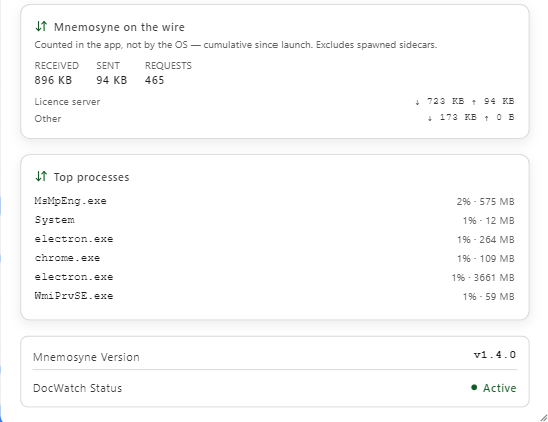
Counted in the app (not by the OS), cumulative since launch. This session: 896 KB received, 94 KB sent, 465 requests — almost all of it the licence server. Meanwhile the OS indexed an entire image library. Your files, your chronicles, your indices: none of it travels. The heavy lifting of your neural map happens entirely at home.
Disk space
What Mnemosyne keeps on disk, measurable on demand — with an honest taxonomy: caches and logs come back on their own; model weights and Python engines have to be re-downloaded or rebuilt.
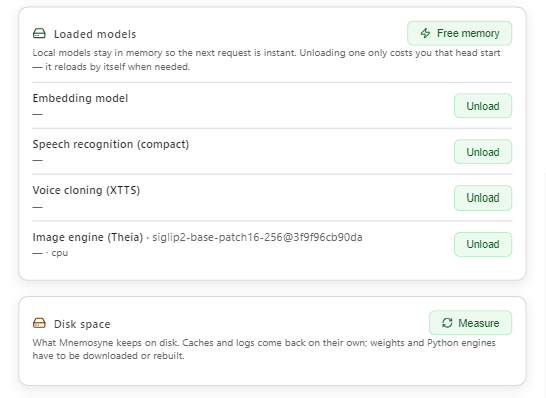
This is the quiet engineering that makes home AI possible — no rented cloud servers, no competition rig required. And you never have to take our word for it: the counters are on your screen.